
When to Use Viber→SMS Fallback — and When to Choose a Different Approach

⏱ Reading time: ~10 minutes
With SMS and Viber, the question is rarely which channel is “better” in general. What matters more is the specific situation: is direct SMS enough, does Viber add real value, is Viber→SMS fallback needed when delivery fails, or would a follow-up message after no response be more appropriate?
In this article, I share how we approach similar cases at Procode. My aim is to help people who are choosing between SMS, Viber and a combination of the two avoid a few common mistakes. There is no universal formula. Every business has different audiences, systems, deadlines and constraints, so the right decision always has its nuances.
Please write to me if something in the article does not match your situation, if you have a question, or if you spot an inaccuracy. Conversations like these often help both sides notice a detail that would otherwise be easy to miss.
What you will learn from this article
- when SMS is the more suitable first channel;
- when Viber adds real value;
- the difference between fallback, a follow-up message and sending through two channels;
- when Viber→SMS fallback is justified;
- how to define clear rules and what to measure;
- which mistakes to avoid before you start sending.
Who this article is for
- people in marketing and CRM teams who use SMS and Viber;
- product and technical teams that decide how their company sends messages to customers;
- businesses that send promotions, reminders, order information, one-time passcodes (OTPs), or other time-sensitive messages;
- teams that want to optimise SMS and Viber spend, limit unnecessary duplication, and gain a clearer view of costs by channel.
1. First, distinguish between the three ways of using a second message

With fallback, you first send the message through Viber. If it cannot be delivered there — for example, because the person does not have Viber or currently has no internet access — an SMS is sent. Rakuten Viber describes SMS fallback as a backup option when Viber delivery fails. However, the exact conditions and wait time depend on the service and configuration used. See Rakuten Viber’s explanation.
With a follow-up message, the reason is different. The first message may have been delivered successfully, but the person has not yet completed the expected action — for example, confirming a reservation or completing a payment. The second message is then a reminder, not a backup delivery method.
When you send through two channels almost simultaneously, you accept that some people will receive the message twice. This makes sense only when the response window is very short and missing it would have a real consequence.
Examples
- Fallback: the message cannot be delivered through Viber, so a short SMS with the same core message is sent.
- Follow-up: the customer received a reservation reminder but has not confirmed it yet. After a set period, they receive a second message.
- Two channels almost simultaneously: an important delivery change must reach the customer within a very short time, so the company deliberately uses both Viber and SMS.
Why this matters for a business: if you mix up the three approaches, it becomes difficult to tell whether the problem is message delivery, the message itself, or the customer not taking action.
What to check:
• why a second message is needed at all;
• whether the first message was undelivered or simply received no response;
• when Viber does not reach the recipient and a backup SMS is needed;
• when the second message is no longer needed;
• where the information that the customer has responded comes from.
What is important to track:
With fallback, track how many messages are delivered through Viber and how many are sent as SMS because Viber could not deliver them. This shows the actual reach of each channel. Then compare recipient response against the number of messages delivered through the respective channel — for example, reads, clicks, confirmations or purchases. This gives you a clearer view of both the effectiveness of each channel and the outcome of the overall campaign.
If the follow-up uses a second channel, track how many recipients receive both messages and what outcome they achieve. Compare this with the outcome for communication through just one channel and for Viber→SMS fallback — for example, in terms of reach, response, clicks, confirmations or purchases.
Track the additional cost, clicks, confirmations or other expected action. Compare results against the chosen approach without mixing up fallback, follow-up messages and sending through two channels almost simultaneously. Also track opt-outs and complaints so that you do not overload customer communication.
2. Choose the first channel based on the message itself
The easiest way to limit unnecessary fallback is to choose the more suitable channel from the start. If the message is short and leads to one clear action, SMS is often enough. If an image, more explanation or a button is needed, Viber may be the better choice.
2.1 When SMS is the more suitable first channel
SMS is practical for one-time passcodes, short reminders, order information and promotions with a clear offer or deadline. Rather than trying to fit the whole offer into the message, keep the essentials and add a link to the details.
Example of a short promotion:
Only until [time]: [offer]. See the terms: [short link]
Example of delivery information:
Your shipment will be delivered today between [time] and [time]. Change the address: [short link]
With SMS, check not only whether the copy sounds good, but also how many message parts it will use. This is especially important for Cyrillic text, because a longer phrase can turn one message into two.
| Character set | Message length | SMS parts |
|---|---|---|
| Latin characters | up to 160 characters | 1 SMS part |
| Latin characters | 161 to 306 characters | 2 SMS parts — up to 153 characters in each part |
| Cyrillic characters | up to 70 characters | 1 SMS part |
| Cyrillic characters | 71 to 134 characters | 2 SMS parts — up to 67 characters in each part |
With longer text, the number of parts continues to increase. Some special characters can also change the calculation. That is why the most reliable practical check is to review the number of parts in the platform before sending. The table is a simplified explanation of the rules in 3GPP TS 23.040 and ETSI TS 123 038.
For more context on the channel, see the SMS messaging page.
What to check:
• whether the core message is clear without ambiguous abbreviations;
• how many parts the SMS will use;
• whether there is one clear action;
• whether the link is recognisable and trustworthy;
• whether this type of message is suitable for SMS.
What is important to track: the number of SMS parts; the status of delivered messages; clicks when the message contains a link; or completion of the intended action (for example, placing an order or activating a code).
The diagram below shows how to choose the first channel based on the message content.

2.2 When Viber is the more suitable first channel
Viber is useful when an image, a longer explanation or a clearly presented button helps the customer understand the offer. Rakuten Viber lists images, files, links and buttons among the capabilities of Viber Business Messages. The specific formats should still be confirmed for the service you use. See the Viber Business Messages overview.
Example of a visual offer:
[Offer image]
[Campaign name] is valid until [date].
[Button: See the terms]
Viber is not the better choice simply because it supports richer content. Be careful: if the image adds nothing and the key information gets lost in a long text, a simpler message may be more effective.
What to check:
• whether the image helps or is only decorative;
• whether the core message is clear without it;
• whether there is a clear next step;
• what the backup SMS will say, if one is needed;
• which formats are supported by the specific service.
What is important to track: message delivery; clicks on the button or link; completion of the intended action; and how often an SMS fallback is needed.
3. When Viber→SMS fallback makes business sense
Fallback makes sense when Viber is the logical first channel, but the message is important enough that you should not rely on Viber alone. The point is not to send the same message through two channels, but to use SMS only if the Viber message cannot be delivered.
The approach is sensible when:
- the Viber message uses an image, more context or a button;
- the information has a real deadline or operational importance;
- missing it would create a specific problem for the customer or the business;
- the backup SMS adds enough value to justify the cost;
- there is separate short copy written specifically for SMS.
Example of when Viber→SMS fallback makes sense:
• in a specific campaign, 80% of Viber messages are delivered;
• you want to reach the remaining 20% for whom the Viber message was not delivered;
• the message is important and the additional SMS cost is justified.
Example: send Viber first, then SMS only if Viber delivery fails:
Viber:
Order [number] is ready for collection. To check the branch opening hours or redirect the order to a branch that is convenient for you: [button]
Backup SMS:
Order [number] is ready for collection. Details: [short link]
The SMS does not repeat the Viber message word for word. It keeps the most important information and the action, but is adapted to the shorter format.
What to check:
• when an SMS should be sent after Viber;
• whether the wait time is sufficient;
• when SMS is justified as a backup channel;
• whether the SMS copy is understandable on its own.
What is important to track:
• how many Viber messages switch to SMS;
• the additional cost;
• whether the recipient completes the intended action and the communication achieves the intended outcome.
4. When a follow-up message or two-channel sending is more suitable
If the first message has been delivered but the customer has not responded, delivery is no longer the issue. A follow-up message is then more suitable, sent only if the expected action is still missing.
Example of a follow-up message:
A reminder: your reservation for [date and time] has not yet been confirmed. Confirm it or change the time: [link]
This message should be sent only if the booking system shows that confirmation is still missing. The fact that the first message was delivered does not mean the customer has done what was needed.
Sending through two channels almost simultaneously is a separate approach. Use it carefully and only when:
- the response window is very short;
- missing it would have a clear consequence;
- you accept the risk that some people will receive the message twice;
- the rule applies only to a specific type of message, not to all communication.
Example of a time-sensitive message:
Your delivery is scheduled between [time] and [time]. If the address is not convenient, change it by [time]: [link]
This is an illustrative scenario, not a ready-made process that can be applied in the same way in every company.
For a broader comparison of the channels, see the article SMS, Viber or WhatsApp — which channel should you choose?
What to check:
• whether there is a real reason for a new message;
• whether it can be stopped immediately after the customer responds;
• how many people will receive the communication through both channels;
• whether there is a lighter option — for example, one clearer first message.
What is important to track:
• confirmations, clicks and completed actions;
• opt-outs and complaints;
• the share of duplicated messages;
• the additional cost required to achieve each extra completed action.
Decision diagram for Viber, SMS fallback, follow-up and two-channel sending in parallel.
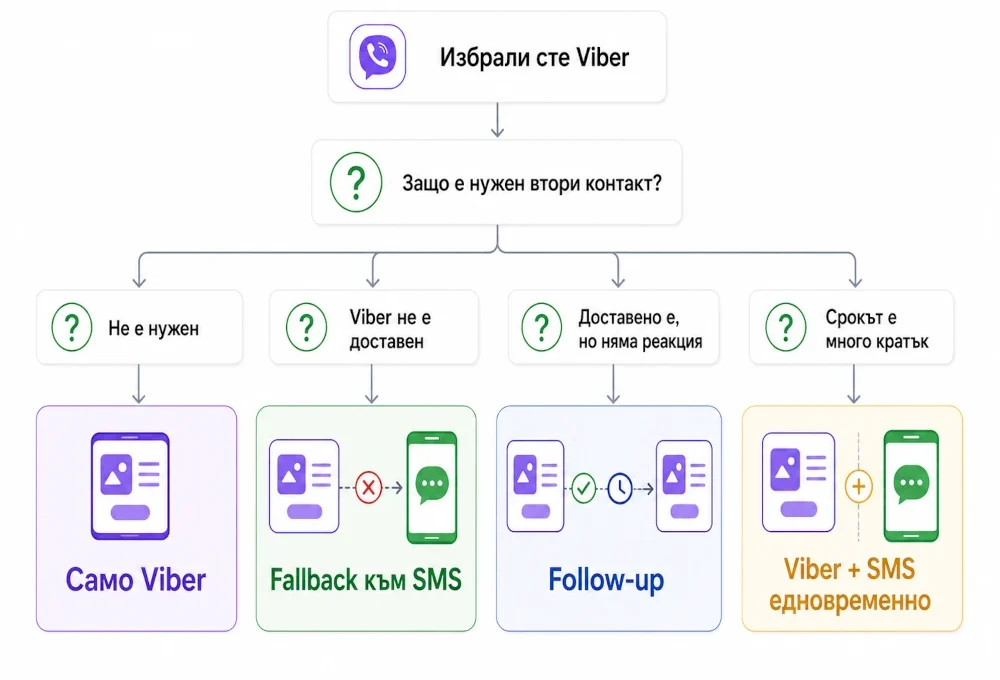
Failed delivery, no response and a very short deadline are different situations. They should not automatically lead to the same approach.
5. A practical decision matrix
The table provides an initial guide based on the content, the deadline and the reason for using a second channel.
| Scenario | Approach | Why | What to check |
|---|---|---|---|
| Short and important message | SMS | The message is direct and does not need an image | Length, number of parts and one clear action |
| Short promotion with a specific deadline | SMS or SMS with a short link | The core offer can be understood immediately | Consent, deadline, trustworthy link and cost |
| Longer or visual message | Viber | More context, an image or a button is needed | Supported formats and a clear next step |
| Viber is the first channel, but the message cannot be delivered | Viber→SMS fallback | An SMS is sent if the Viber message cannot be delivered | When a backup SMS is needed and separate SMS copy |
| The first message was delivered, but the customer has not responded | Follow-up message | A reminder is needed, not a backup channel | Whether the action is still missing and when to stop the message |
| Important message with a very short deadline | Two channels almost simultaneously | The risk of missing it is greater than the inconvenience of duplication | Limited scope, frequency, cost and complaints |
Use the matrix as a starting point, not as an automatic rule. If you cannot explain in one sentence why a second channel is needed, the decision is probably not clear enough yet.
6. How to prepare the rules before sending
Start with a few important types of messages — for example, a passcode, order information, a reminder and a marketing campaign. Do not apply the same rule to everything.
For each message type, clarify:
- What is the objective and what do you expect the customer to do?
- What is the main channel, and why?
- Is a second channel needed, and what problem does it solve?
- Under what condition is the second channel needed — because the first message did not arrive or because the customer has not responded yet?
- At what point should the second message no longer be sent?
- What will the separate SMS and Viber copy look like?
- If this is a reminder or two-channel sending almost simultaneously, what interval is appropriate?
- How will you measure delivery, response, cost and duplicate sending?
6.1 Common mistakes
- Copying Viber text word for word into an SMS
A long or visual Viber message should be reduced to the core information and action. If the SMS becomes longer and uses more parts, the cost may increase. - Mixing fallback and follow-up messages
Failed delivery and no response are different problems. They therefore need different rules. - One rule for every message
A passcode, a promotion and delivery information have different logic, importance and timing. Using the same pattern for all of them rarely makes sense. - Measuring only the number of sends
The number of messages sent does not show whether the communication was useful. You also need to track the expected action.
6.2 Short checklist
- One main channel has been clearly selected.
- The reason for the second channel is clear and specific.
- SMS and Viber have separate, suitable copy.
- The second message can be stopped when it is no longer needed.
- Delivery and response are considered separately.
- Consent, frequency and the rules for the relevant market have been checked.
- The change has been tested before sending to a real audience.
The key points in brief
Viber→SMS fallback is useful when Viber is the right first channel, but you need a backup if Viber delivery fails. It should not become a general rule for sending a second message.
SMS is a good choice for short, direct messages. Viber is suitable when an image, more context or a button helps. A follow-up message is sent when the customer has not yet taken the expected action, while using two channels almost simultaneously should remain a limited exception.
In my view, the best approach is not to use more channels, but to have a clear reason for each one, separate copy, and clear rules for when the next step is needed.
Do you have a specific case?
Send a short description of two or three main message types: which channel you use first, when you add the second one and what you expect the customer to do. If you have different practical experience or spot an inaccuracy in the article, I would also be happy to discuss it.
Frequently asked questions

Todor Sbrikov
Founder and Marketing Director
Helping B2B teams engage customers and automate messaging workflows across SMS, Viber, email, and more.