
How to manage customer notifications more practically in 2026

⏱Reading time: ~9 minutes
If you actively send messages to customers, you’ve probably felt it already: sending a campaign is easy. The hard part is not overdoing it. In this article, I look at how the customer notifications process changes in 2026: message types, channel selection, frequency, fallback, and measurement.
In 2026, the problem isn’t “can we send a message,” but “are we sending the right message, through the right channel, at the right moment — without annoying the customer and without inflating volume and costs.” Marketing, CRM, and product teams see the wrong approach as declining effectiveness, more opt-outs, and misalignment between campaigns and channels.
What you’ll learn from this article
In short — I’ve pulled together, in one place, the things that most often save us time and prevent mistakes when we message customers. Here’s what we’ll cover:
+ how to structure your message types;
+ how to introduce frequency limits;
+ how to coordinate channels (including multi-channel fallback);
+ and what to measure to optimize the impact of “sending.”
How you’ll know it’s working
Expect fewer opt-outs, more stable CTR, and fewer duplicated messages across channels. After 2–4 weeks, compare results by flow, not just by the number of “sent” messages.
The goal is control: less duplication, less noise, and a more predictable outcome.
Who this article is for (and who it isn’t)
Who it’s for:
+ Product, marketing, and CRM teams in companies with lots of end customers — for example e-commerce, financial institutions, fintech, iGaming, and SaaS — that actively communicate across 2+ channels.
+ Companies with a channel mix (e.g., SMS, Viber, WhatsApp, Push notifications, email), but without clear rules and measurement.
+ Teams that want to reduce opt-outs and increase impact without “pushing” frequency.
+ Organizations that want to build on a process: rules, roles, traceability, tests.
Who it’s NOT for:
+ If you have only one channel and send rarely (a few campaigns per month) — a bit more discipline is probably enough.
+ If you’re looking for an article focused only on regulations and legal interpretations — I deliberately don’t go into that here.
+ If you expect “universal benchmarks” for frequency and results — this depends heavily on industry, offer, and audience.
+ If you only send transactional alerts (receipts, order statuses) and almost never run promotions and campaigns — it may help you partly, but the focus here is on marketing use cases.
1. What changes in customer notifications in 2026 — and why “more messages” is now a risk
2. Rules that protect customers (and your budget)
3. Channel coordination: fallback rules and trackable statuses
4. How to organize your customer notifications tools
5. Measure & improve: from “we sent” to “measurable impact”
6. The essentials + first steps for 7 days
7. Conclusion
8. Frequently Asked Questions (FAQ)
1. What changes in customer notifications in 2026 — and why “more messages” is now a risk

Channels compete for the same attention. That’s why “one more campaign” is riskier — and often more expensive when it’s out of context or poorly timed. At the same time, expectations for personalization are rising: customers want communication aligned with their preferences and needs, not “one message for everyone.”
The practical approach isn’t to argue which channel is “best,” but to manage notifications as a process. The most effective framework is:
Message type → Primary channel → Fallback → Measurement
In other words: first you decide what type the message is (e.g., promotion, abandoned cart, win-back, reminder, re-engagement). Then you choose the primary channel based on context and segment, set clear fallback rules (when and for whom it should trigger), and finally measure outcomes by flow, not just “sent.”
What to do/check (the minimum to stay in control):
- define 3–5 types of marketing messages (Promotions & Campaigns, cart recovery, win-back offer, Reminders, re-engagement),
- set “deadline/urgency” (time-sensitive or not),
- create a matrix type → primary channel → fallback and segment at least at two levels: high-intent customers and “everyone else.”
Mini scenario:
Cart recovery flows: send via Viber first; use SMS only as fallback for high‑intent customers after 2 hours with no read/click.
What to track:
Opt-out by message type + CTR by channel for the same offer (so you can see whether the issue is the offer or the channel).
With this framework in place, the next risk is pressure: if preferences and frequency aren’t managed, even the right channel loses impact. In the next section, we go through preference management and frequency limits.
2. Two rules that protect customers (and your budget): preferences and frequency
Put simply: the customer should have control over what they receive and through which channel, and you should control how often you contact them. Even the best copy loses impact if the person on the other side receives too much, too often, or at the wrong time.
There are two simple rules that almost always deliver:
- Preference management: the customer chooses topics/categories (e.g., promotions, reminders, recommendations), channels, and frequency — instead of only “unsubscribe.”
- Frequency limits: rules that limit how many promotional messages a customer can receive in a period (overall or by type), so you don’t end up with fatigue and opt-outs.
This approach isn’t complex—it’s the difference between useful communication and noise. The first protects relevance. The second protects the channel and the brand from overload.
There’s no universal “right frequency” — that’s why we use a baseline + calibration
Frequency depends on industry, audience, and offer. Instead of chasing “universal benchmarks,” the approach is practical: start with baseline rules and then calibrate based on signals (CTR, conversion, opt-out).
Here’s the minimum baseline I recommend having from day one. The table below summarises the core elements and how to apply them in practice.
|
Element |
Practical implementation |
|---|---|
|
Preference management |
Minimum: topics/categories + channel choice + easy opt-out (and clarity on what “opt-out” actually means) |
|
Frequency limits |
Limits by message type (not only an overall limit). Separate rules for promotional and transactional messages |
|
Quiet hours |
Quiet hours for promotions; |
|
Measuring “overdoing it” |
Opt-out by segment and message type + share of customers who received 2+ promotional messages in a short period. |
Sample frequency rules (a starting baseline that you calibrate later):
- Promotions: maximum 2 promotional messages per 7 days per customer (across all channels).
- Win-back / re-engagement: maximum 1 message per 7–14 days (less frequent, but with clearer value)
- Quiet hours: no promotions 21:00–09:00, exceptions only for time-sensitive messages.
The point isn’t that these numbers are a “gold standard,” but that you have a starting point. After 2–4 weeks, you adjust them based on real data.
Mini scenario:
You run a weekly promotion and a win-back campaign for inactive customers.
You set frequency limits so a customer won’t receive both on the same day. If the win-back is time-sensitive, it takes priority and the promotion is delayed.
What to track:
Opt-out by segment and type + share of customers with 2+ promotional messages in a short period.
If CTR drops and opt-out rises at the same frequency — you’re pushing beyond tolerance.
With pressure under control, the next step is to coordinate channels instead of duplicating them. The next section, we move to fallback rules and trackable statuses.
3. Channel coordination: multi-channel fallback rules and trackable statuses

In other words, multichannel works only when channels are coordinated. Otherwise you get duplication: the customer receives the same thing via two or three channels — and response drops. The fix is simple: clear fallback rules + traceability (knowing what happened to the message).
Rule #1 (anti-duplication): for one flow, there is one primary channel and one fallback.
If you send the same message through two channels at the same time, you often pay twice for the same reaction — and you increase opt-outs.
What “traceability” means in practice: for each flow, you should be able to answer 4 questions:
- Was it delivered? If not — why (a human-readable reason, not a technical code).
- Was it seen? (if the channel provides such a signal)
- Was there a response? click/visit/conversion (depending on the flow goal)
- When and why was fallback triggered? (by rule, not “gut feel”)
When it makes sense to trigger fallback:
- when the primary channel is not delivered, or
- when there’s no response within a reasonable window (e.g., 1–2 hours), but only for a high-priority segment (high-intent).
Important: fallback does not override the rules from section 2 — frequency limits, quiet hours, and preferences apply here too. Otherwise, you’re simply increasing pressure and accelerating opt-outs.
Mini scenario:
You launch a cart recovery flow. First you send Viber with Rich Media and a short link. If there’s no read (read receipts) or click within 2 hours, you trigger fallback to SMS only for high-intent customers. This avoids mass duplication and keeps spend under control.
What to track:
+ Share of the audience that went through fallback (how often the primary channel “fails,” or whether your rule is too aggressive).
+ Difference in CTR and opt-out between the primary channel and fallback for the same flow (whether fallback adds real value or just noise).
4. How to organize your customer notifications tools: CPaaS for channels and SaaS for orchestration
Once you have rules for message types, frequency, preferences and fallback (sections 1–3), the next question is where to manage them. This is where many teams slip into tool chaos: one tool for SMS, another for email, another for push, plus manual lists. The result is predictable — rules get blurred, changes become slow, and the risk of duplication grows.
A two‑layer approach is more practical (see the diagram):
- A layer for channel delivery that handles sending, routing, delivery status, executing fallback rules, and traffic controls. See our Multi-Channel Messaging Platform (CPaaS)
- A layer for orchestration that handles segmentation and automated journeys. See our Customer Engagement Automation Platform (SaaS)
Quick test (10 seconds):
- If the topic is delivery / status / failure reasons / retry rules → that’s CPaaS.
- If the topic is segment / flow logic / what to send and when / measurable impact → that’s SaaS.
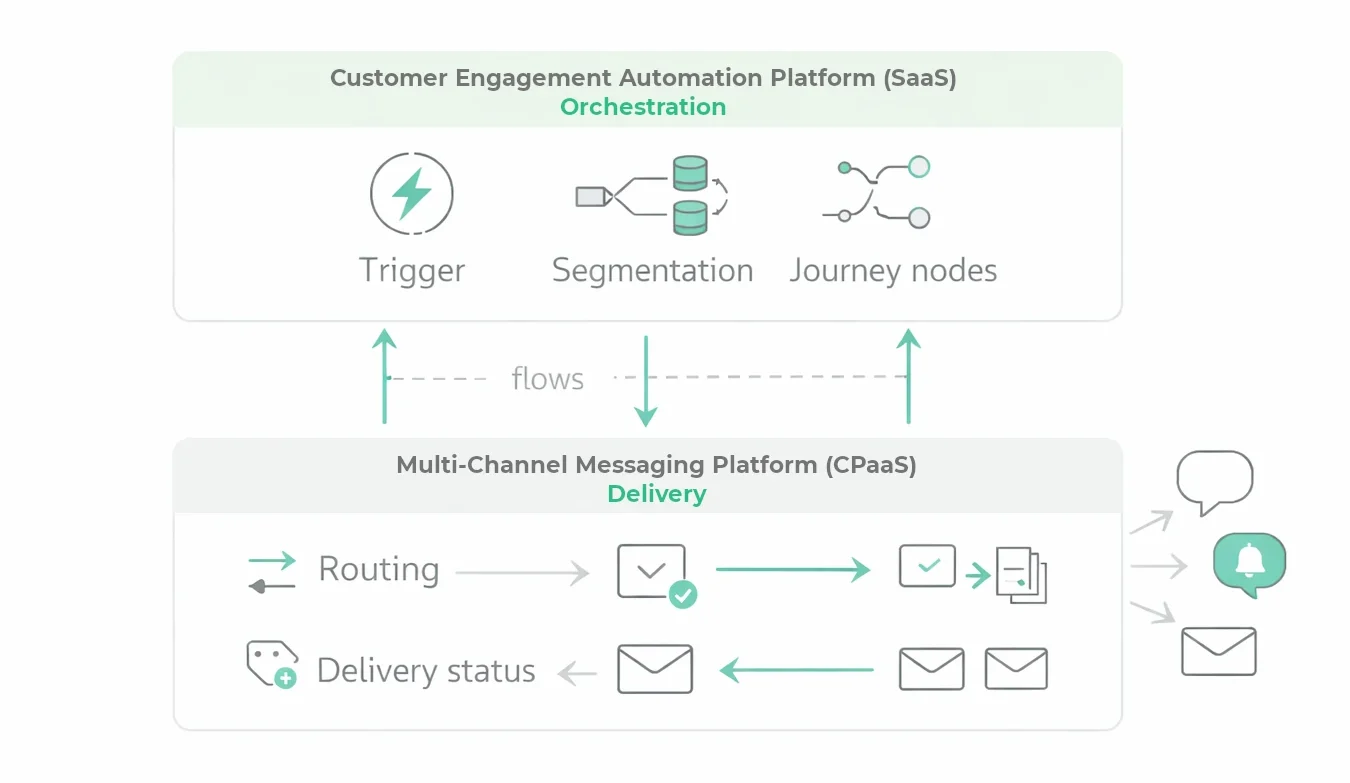
A practical framework (to avoid accumulating complexity):
|
Layer |
Responsibilities |
|---|---|
|
Channels (CPaaS) |
Sending and routing; |
|
Orchestration (SaaS) |
Segmentation and triggers; |
|
Shared requirements |
API/CRM triggers to CRM/store/product; |
|
System health metric |
Time-to-market for flow changes + number of manual audience exports/imports (if there are many — you have chaos and a higher risk of mistakes). |
Mini scenario:
Event — a customer views a product three times and doesn’t buy. The SaaS layer selects the segment and starts a re-engagement flow. The CPaaS layer sends first via a chat channel; if there’s no reach/response per rule, it triggers fallback (within your frequency limits and quiet hours). This gives you one flow and one logic, instead of three separate “channel campaigns.”
5. Measure & improve: from “we sent” to “measurable impact”
If you measure only “sent,” the natural reflex is to increase volume — and raise noise. A better framework is simple: Evaluate, improve, repeat. That means clear KPIs, a few tests, and a steady cadence of experimentation.
Start with one KPI dashboard with at least 5 metrics you track by flow (not only overall):
- Delivery status (delivered/failed + reason)
- CTR (or another engagement signal, if there are no clicks)
- Conversion by flow (purchase/request/next step)
- Opt-out (by message type and segment)
- Cost (by channel and message type, especially when fallback is involved)
An important habit: separate “offer problem” from “channel problem.” Follow this rule:
For the same offer, compare results across channels;
For the same channel, compare different offers.
This gives you cleaner diagnosis.
A common pitfall: if you change offer + channel + frequency at the same time, you won’t know what actually moved the result. Change only 1 variable per test.
What to do/check:
1. Build a KPI dashboard with the 5 metrics above by flow and segment.
2. Introduce a testing rhythm: 1–2 A/B tests per week for the highest-priority flow.
3. Watch for “fatigue”: if CTR drops and opt-out rises at the same frequency, you’re likely pushing beyond tolerance.
4. Use AI to help with copy variants and ideas, but humans set the rules (segments, frequency, limits).
5. Distinguish impact from volume: fewer messages can drive more conversions if the rules are good.
What to track:
+ Conversion by flow (not just by message)
+ Opt-out and negative signals (if you track them), by message type and segment
+ Cost by channel and message type, especially with fallback
+ CTR by channel for the same offer (cleaner diagnosis)
📌 If you measure impact, not just “sending,” you’ll improve rules and flows sustainably instead of increasing noise.
🎯 AI can help (for example, by suggesting copy variants), but it doesn’t replace rules, segmentation, and discipline. If the foundation is chaotic, AI will produce more variants of the chaos.
6. The essentials + first steps for 7 days
In the end, in 2026 discipline wins: message types, frequency rules, channel coordination, and measurement. Preference management and frequency limits are fundamentals, not “nice-to-haves.” And fallback works when it’s selective and measurable — not as mass duplication.
To go through the steps in 7 days, you need at minimum: 1–2 channels, 1 key flow (e.g., cart recovery), and basic click/conversion tracking.
Appendix: first steps for 7 days
Day 1: Define 5 message types and a goal for each.
Day 2: Create a matrix “type → primary channel → fallback” (e.g., Viber→SMS fallback for time-sensitive use cases).
Day 3: Set quiet hours and initial frequency limits for promotions.
Day 4: Implement minimum preference management: topics + preferred channel + easy opt-out.
Day 5: In parallel, define flow statuses (delivered/failed/response) and failure reasons so they’re easy for the team to understand.
Day 6: Build a KPI dashboard with 5 metrics: deliverability, CTR, conversion, opt-out, cost.
Day 7: Choose 1 flow (e.g., cart recovery) and run your first A/B test.
Expected result by the end of the week: 1 working flow + a KPI dashboard + clear frequency and fallback rules for at least 1 segment (high-intent).
What to track:
Opt-out by message type, CTR by message type and channel, and the performance difference between the primary channel and fallback for the same flow.
If you want to move faster: take a look at our Automation Strategy Sprint (4–6 weeks).
7. Conclusion
In 2026, the biggest difference isn’t which channel “wins,” but whether you manage customer notifications as an organized process:
- clear message types,
- preference management,
- frequency limits,
- fallback rules,
- measure & improve.
When this foundation is solid, your customer notifications become more effective and channels work together.
To see where you stand and get a tailored plan for your customer notifications, request a free review (15–20 min): send 2–3 sentences about your channels + your 3 main flows. We’ll come back with a prioritized plan: message types, frequency limits, fallback rules, and what to measure first.
Measure impact, not volume: CTR + conversion + opt-out + cost, by flow and by segment.
📬 If you want to see where you are on this path, we can do a short review of your customer notifications and channels and suggest specific next steps.
Frequently Asked Questions (FAQ)
📝 All examples in this article are illustrative and aim to show how process, rules, and measurement make customer notifications more practical and predictable. To automate these flows and manage customer engagement, see our Customer Engagement Automation Platform (SaaS).

Todor Sbrikov
Founder and Marketing Director
Helping B2B teams engage customers and automate messaging workflows across SMS, Viber, email, and more.